The retail problem: sales data does not always tell you who your best customers are
Retail businesses generate a large amount of transaction data every day. POS systems record purchases. eCommerce platforms record online orders. Finance teams see revenue. Store teams see footfall. Yet many retail owners still have limited visibility into which customers are returning, how often they purchase, what categories they prefer, and how their behaviour changes over time.
That gap matters because repeat customers are not simply another line in a sales report. They can become a predictable source of revenue, advocacy and long-term customer value. When customer identity and purchase behaviour are fragmented across stores, websites and manual records, retailers are forced to make retention decisions using assumptions rather than evidence.
Why returning-customer visibility is difficult
The challenge usually starts with fragmented customer data. A shopper may purchase in a physical store using a phone number, place an online order using an email address and later interact through a mobile channel. If those touchpoints are not connected, the retailer may see three activities instead of one customer journey.
Customer profiles may exist separately across POS and eCommerce systems.
Store teams may not know whether a shopper is new, returning or high value.
Loyalty rewards may be tracked manually or through disconnected applications.
Marketing campaigns may target broad audiences instead of customer segments.
Management may see revenue reports without a clear view of retention and repeat-purchase behaviour.
The real cost of not understanding customer behaviour
When retailers cannot identify returning customers, they lose the ability to treat different customers differently. A first-time shopper, a frequent buyer and a customer who has not purchased for six months should not necessarily receive the same engagement. Without customer behaviour data, the business may over-discount loyal customers, ignore customers who are becoming inactive, or miss opportunities to reward high-value shoppers.
How Karts Growth helps retailers turn customer data into action
Karts Growth is designed to help retailers build a clearer view of returning customers and create structured loyalty and engagement programs around real purchase behaviour. Instead of treating loyalty as a standalone points mechanism, the objective is to connect customer identity, transactions, rewards and engagement into a retail retention workflow.
Identify returning customers and view purchase behaviour over time.
Create points, rewards, tiers and loyalty rules based on the retailer’s strategy.
Segment customers using relevant behavioural and transactional data.
Build targeted engagement for valuable, frequent or inactive customers.
Track loyalty activity and redemption so management can understand how the program is being used.
From “Who bought?” to “Who came back?”
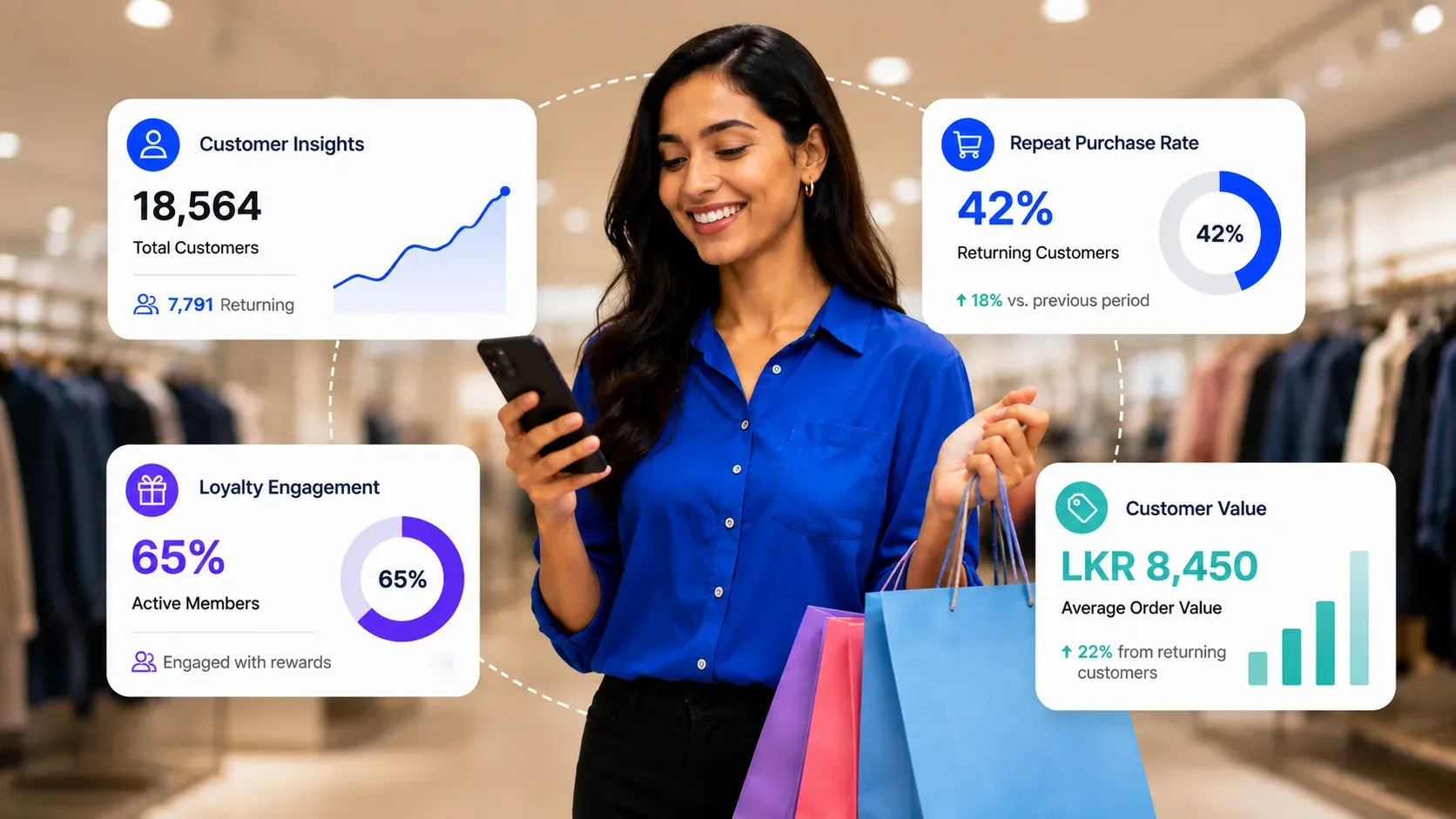
A useful retail customer strategy starts by moving beyond transaction reporting. Instead of only measuring total sales, retailers can ask questions such as: What percentage of customers return? Which customer segments purchase most frequently? Which categories are associated with repeat behaviour? Which members are close to the next reward or tier? Which valuable customers have stopped purchasing?
These questions create a stronger foundation for retention activity because the retailer can make decisions based on customer behaviour rather than broad promotions.
Practical ways retailers can increase repeat sales
Reward meaningful behaviour, not just every transaction. Design rewards around purchase frequency, value, product categories or milestones.
Create customer segments. Separate new, active, high-value and inactive customers so engagement can be more relevant.
Use purchase history to improve timing. A customer who purchases a replenishable category may respond better when communication is timed around expected repurchase behaviour.
Make rewards easy to understand and redeem. Complicated loyalty mechanics create friction for customers and store staff.
Measure retention outcomes. Track returning customers, redemption, engagement and repeat-purchase trends rather than judging success only by member registrations.
What retailers should look for in a loyalty platform
Retail loyalty software should fit into the existing retail environment. That means supporting the retailer’s customer journey, channels and system landscape rather than forcing the business into a generic process. Where Karts connects with third-party eCommerce, POS, ERP, payment or other systems, the required APIs and technical documentation must be available from those system providers.
Key takeaway
Retailers do not need more customer data for its own sake. They need a practical way to understand who returns, how those customers behave and what actions can increase retention. Karts Growth helps turn customer and transaction data into a structured loyalty and engagement program designed around repeat sales.
Frequently asked questions
What is retail customer loyalty software?
Retail customer loyalty software helps retailers identify and engage customers using purchase and loyalty data. Depending on the platform, it can support customer profiles, points, rewards, tiers, segmentation, campaigns and reporting.
How can retailers identify returning customers?
Returning customers can be identified when customer identity and transaction data are captured consistently across relevant channels. The exact approach depends on the retailer’s POS, eCommerce and customer-identification methods.
Can Karts Growth connect with an existing POS or eCommerce system?
Karts can integrate with third-party systems when the required APIs and technical documentation are available from the existing system providers. Integration feasibility is reviewed before implementation.
Does a loyalty program automatically increase sales?
No platform can guarantee sales growth by itself. Results depend on the offer, customer experience, adoption, data quality and how effectively the retailer uses customer insights to design engagement and rewards.